What Ponchatoula's weather does to a roof
Ponchatoula sits just above the Manchac swamp, with Lake Maurepas and Pass Manchac to the south. Tall pines and live oaks shade most of town. The air stays wet most of the year and summers run long and hot. On a roof that shows up three ways. Black algae streaks spread across the shaded slopes. The sunny slopes shed granules and the shingles start to curl. Pine straw piles up in the valleys and gutters and holds water against the roof.
Add hurricane season, June through November, and the afternoon thunderstorms in between. Most leaks start small: a lifted tab, a cracked pipe boot, flashing that pulled loose where the roof meets a wall.
If your roof went on after Ida
Hurricane Ida came through in 2021 and left blue tarps across Tangipahoa Parish. If your Ponchatoula roof was replaced in the year or so after, it's about five years old now.
That's a good age for a first real check. The shingles are still sound, but five summers of heat can dry out the sealant around vents and pop a few nails. A thunderstorm may have lifted tabs along the edges without tearing anything off. None of that costs much to fix yet. Left for a few more seasons, it's how water gets under the shingles and into the decking.
A roof tune-up is built for exactly that kind of small stuff.
Antique City houses, farm lots and new subdivisions
Ponchatoula calls itself America's Antique City, and some of its roofs have a history to match. The older wood-frame houses near downtown tend to carry patched valleys, old flashing around chimneys and vent pipes added over the years. Out on the country roads, homes on acreage have pines leaning right over the roofline. The needles and limbs come with them. The newer subdivisions on the edges of town have younger shingles, but they get the same wind and the same sun.
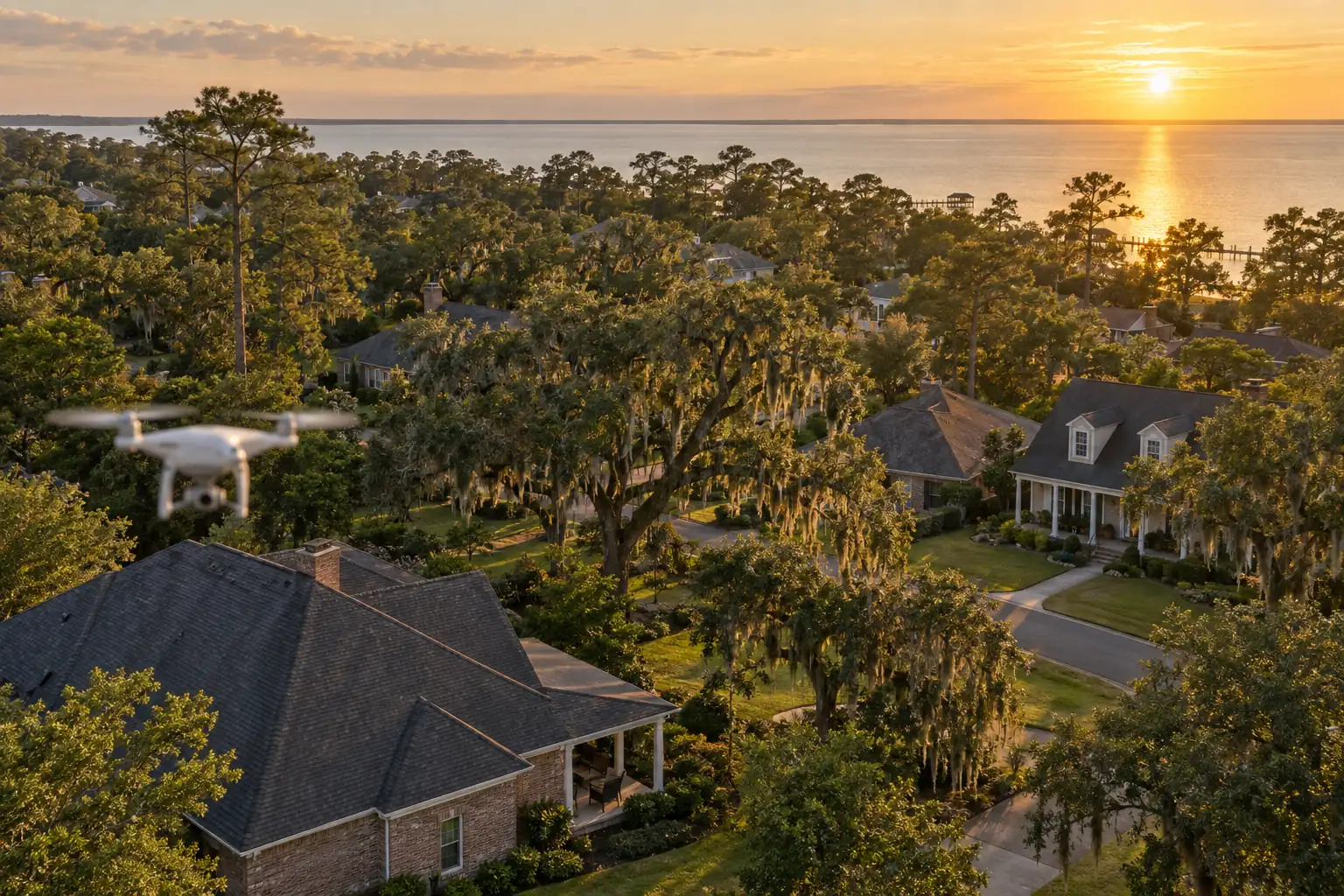
Each one wears out in its own way. The drone photos show which problems your roof actually has, slope by slope, so the talk starts from what's up there instead of a guess.
Sorting a Ponchatoula roof into the right work
After the flight, John puts every roof in one of three places. Pretty much every roof needs some kind of maintenance. Far fewer need a new one.
- Maintenance for a sound roof: cleaning, a tune-up and, on shingles with life left in them, a soy-based treatment. See roof maintenance.
- Repair for a specific problem, like storm damage or a leak at a boot. See roof repair.
- Replacement when the roof is genuinely done, with the photos that show why. See roof replacement.
If your roof is fine, that's what you'll hear.
Home base: from Old Town out to the strawberry farms
We work all over Ponchatoula, starting downtown, where the Strawberry Festival takes over every April. From there it's the neighborhoods along US-51, the strawberry farms outside town and the roads running south toward Manchac. I-55 runs right past town, so Hammond is a short hop north, and LA-22 takes us east toward Madisonville.
Book a free drone inspection and the photos are yours to keep, even if we never do the work. The FAQ page answers the usual questions.
Common questions
Is Roof Defend USA actually based in Ponchatoula?
Yes. Roof Defend USA is run from Ponchatoula by John Gagliano, and Tangipahoa Parish is home. That matters most after a storm, because nobody is driving in from another state to look at your roof. It also means you can find us next year if you have a question about the work.
My Ponchatoula roof went on after Hurricane Ida. Does it need anything yet?
Probably not much, but it's worth a look. A roof that age can already have popped nails, a tab lifted by a summer storm or dried sealant around a vent. Those are small, cheap fixes now. The drone inspection is free, and if nothing needs doing we'll tell you and leave it alone.